PVC Flooring Definition: What It Is, Types, Structure, and How to Choose
Home > News > Industry News > PVC Flooring Definition: What It Is, Types, Structure, and How to Choose



Content
Walk into any flooring showroom and you will hear "PVC," "vinyl," and "SPC" used almost interchangeably. For a buyer comparing quotes or reading a spec sheet, this ambiguity can be costly. A flooring product labeled "PVC wear layer" may not behave the same as one labeled "SPC rigid core," yet both sit on the same aisle. This guide gives you a clear PVC flooring definition, a breakdown of the most common types, and the performance data you need to choose with confidence.
PVC flooring is a resilient flooring product manufactured primarily from polyvinyl chloride (PVC), a synthetic thermoplastic polymer. The material is compounded with plasticizers, stabilizers, fillers, and pigments, then formed into flexible or rigid planks and tiles. In the flooring industry, "PVC" and "vinyl" are the same material, so a PVC floor is a vinyl floor.
Definition: PVC flooring is a multi-layer synthetic floor product whose core, print layer, and wear layer are all derived from polyvinyl chloride. It is distinct from laminate flooring, which uses a wood-based high-density fiberboard core.
A modern PVC floor never relies on a single material. The wear layer controls scratch and stain resistance. The decorative film delivers the wood or stone image. The core determines dimensional stability and underfoot feel. The backing layer provides acoustic insulation and moisture protection. Two products with the same name can therefore perform very differently when installed.
Four installation formats dominate the PVC flooring market. Each one solves a different problem and suits a different project.
Manufacturers with in-house compounding, like Jiangsu Tiande New Material And Technology Co., Ltd., can produce the full range without outsourcing critical layers.
Dry-back PVC is the most classic format. The plank or tile is glued directly to the subfloor with a pressure-sensitive adhesive. It delivers the tightest seal and is the most common choice for commercial spaces where moisture and heavy foot traffic are expected.
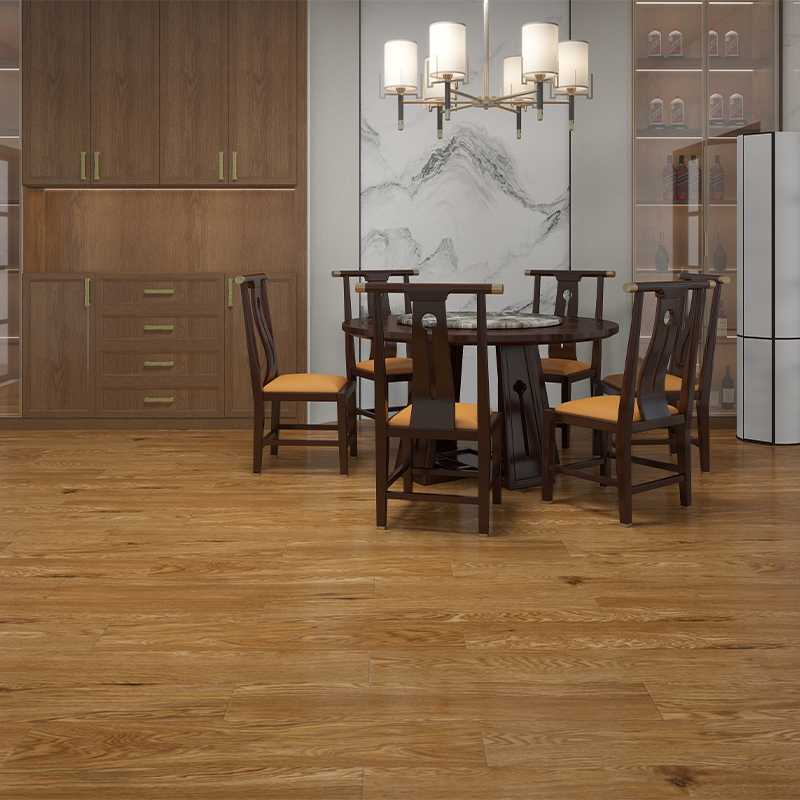 Waterproof Dry Back PVC Wood Plank Flooring for Adhesive InstallationThis dry-back PVC flooring offers a slim profile and permanent adhesive bonding, providing a stable and secure surface. With Bfl-s1 fire rating and waterproof properties, it suits moisture-prone areas like kitchens and basements, balancing performance and cost-effectiveness.View Product →
Looselay flooring uses a heavy backing that grips the floor without adhesive. It is ideal for areas where you need quick installation or frequent access to the subfloor. Looselay is also the format most preferred in renovation projects where existing flooring cannot be removed.
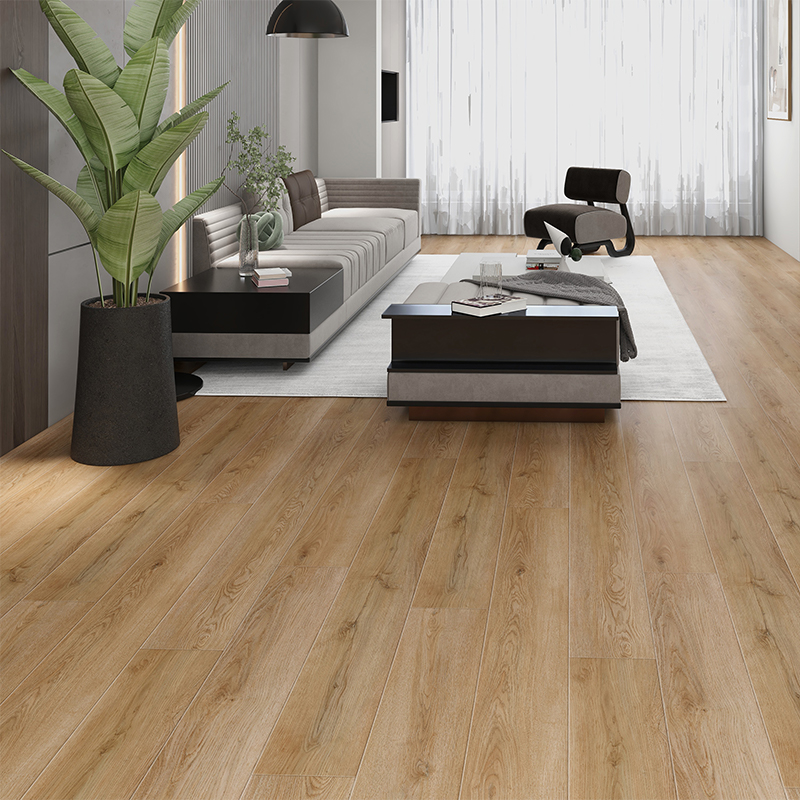 Commercial Glue-Free Looselay Vinyl Plank FlooringDesigned for heavy-duty use, this 5mm looeselay vinyl plank features a friction-based backing for adhesive-free installation. Its high-grade wear layer resists scratches and impacts, while full waterproofing and Bfl-s1 fire rating make it ideal for busy commercial spaces.View Product →
Self-adhesive flooring comes with a pre-applied adhesive film. You peel the backing and press the plank in place. It is the fastest option for DIY homeowners who want a fully waterproof surface without installing click-lock joints.
SPC stands for stone plastic composite. It uses a rigid limestone-based core that locks together with a click system. SPC is a PVC flooring product, but its core is much harder and more dimensionally stable than flexible PVC. It is engineered for long spans, high temperature changes, and heavy rolling loads.
Every modern PVC floor is built from four distinct layers. This structure determines how the floor performs over time.
| Layer | Material | Thickness | Function |
|---|---|---|---|
| Wear Layer | Clear PVC or PUR | 0.2-0.7 mm | Scratch and stain resistance |
| Print Film | PVC decorative film | 0.1-0.2 mm | Design fidelity |
| Core | Flexible PVC or SPC | 1.0-5.0 mm | Stability and comfort |
| Backing | IXPE, cork, or EVA | 0.5-2.0 mm | Acoustics and insulation |
Key insight: the wear layer alone accounts for up to 30% of the product cost. Thicker does not always mean better, but it is the most reliable indicator of lifespan.
All SPC flooring is PVC flooring, but not all PVC flooring is SPC. The difference lies in the core.
Softer and quieter underfoot. It bends easily and can be glued down. It is more forgiving on uneven subfloors but can telegraph imperfections over time.
Harder and more stable. It resists indentations from heavy objects and is unaffected by temperature swings. It requires a flat subfloor because the core will not bend.
 Waterproof SPC Click Plank Flooring with Rigid CoreThis SPC flooring combines PVC resin and limestone for a rigid core, ensuring dimensional stability and low expansion. Its 100% waterproof construction and Bfl-s1 fire rating, plus a tongue-and-groove locking system, enable quick, tool-free installation in high-moisture environments.View Product →
Performance Comparison: Flexible PVC vs. SPC Core
Relative performance based on material properties and typical product specifications.
There are four installation methods for PVC flooring. Your choice depends on the subfloor, the room access, and whether the space is a new build or a renovation.
Maintenance is straightforward. Sweep or vacuum to remove grit, then clean with a pH-neutral cleaner. Avoid steam mops on flexible PVC floors, as excessive heat can soften the wear layer and create warping.
Tip: always install PVC flooring on a dry, flat subfloor. A 2 mm flatness tolerance avoids visible telegraphing and soft spots.
Start with the environment, not the aesthetic. Every specification decision should follow from the conditions on site.
There is no functional difference. PVC is the chemical name for polyvinyl chloride, and vinyl is the common industry term. A PVC floor and a vinyl floor refer to the same product category.
Most PVC floors are waterproof or highly water-resistant. The key is the core. Flexible PVC is water-resistant but can soften under heat and prolonged submersion. SPC rigid core is completely dimensionally stable and is the safest choice for bathrooms and kitchens.
Residential PVC flooring typically lasts 15 to 25 years with proper care. Commercial installations last 5 to 10 years depending on traffic and maintenance. The wear layer thickness is the main predictor of lifespan.
PVC is a plastic material, so it is not biodegradable. However, modern manufacturing uses low-VOC compounds and recycled content. Look for products with a formaldehyde-free core and third-party environmental certifications.